Even bad guys

Even bad guys

I’m sure every mom says this, but my four-year-old is really smart. Okay, he keeps running into doors and things, but… in other ways, he’s extremely intuitive and sensitive. Either way, I enjoy talking to him. He keeps me on my toes.

We were in the car, headed home from our weekly excursion to the grocery store, when Donovan said, completely unprovoked,

“God made some mistakes when he made bad guys, but that’s okay.”

One of the ethical failings of his superhero obsession, perhaps, is this black and white thinking. Oh well, I’m not one of those parents to limit his interests. I responded,

superman

“No, buddy, God doesn’t make mistakes. People make mistakes. People are born as is, and then they choose to be good or bad.” I cringed, thinking about the finality of those labels in simplistic preschool understanding of morals, then added: “People make good decisions and bad decisions. You can always change and be good. Jesus loves everyone anyway.”

The car was silent for a moment before Donovan responded.

“Jesus loves everyone? Even bad guys?!”

“Yup. Even bad guys.”

“That’s just CRAZY!” he exclaimed.

“That’s what makes him Jesus,” I said, drifting my car into the next lane a little too early, wondering immediately what sort of drastic effects this conversation might be having on my child.

“Wow,” said Donovan, stunned.


I’ve written before about radical love for bad people, but of course, I try to portray it as something that adults would grasp. A wonderful, kindly progressive view with perfect lens of perfect theology. It’s much, much harder to explain these concepts to a child, especially one as impressionable and deep as Donovan.

What I want to do is explain to Donovan that maybe bad people aren’t “bad,” they had bad experiences along the way and no one ever taught them how to react the right way. That maybe they have some sort of mental illness that was untreated, or a vengeful spirit to ease some burden of pain. On the other hand, what is his perception of “good?” Someone who stops crime? He really, really likes policemen and firemen. I have never corrected him because I want him to know these are good people that he should turn to if he needs help. But I wonder what he would think if he understood the news in Baltimore. I told him police are as close as it gets to real life superheroes and he loved that sentiment. Those narratives of good cops stopping bad criminals are more common than the reverse. It doesn’t take away the other reality of complicated issues and racism and law enforcement, which certainly do exist. Life is so much more painful than that. I know that. But he doesn’t.

Before I had kids, I had a vision of how I would raise them and what I would teach them and how we would do things differently. I’m pretty proud of myself for some of the things I’ve managed so far in my parenting, but I’m always falling short of perfection, and I always will. I can’t help but wonder if the effects of superhero morals will linger – and if they do, is that a bad thing?

Ultimately, kids do think in black and white. And I want him to think on the “good” side, at least for now. The typical Superman style of morals. Because I know it won’t last forever and the grey will come seeping in.

With the one addendum: yes, Jesus loves the bad guys too. They were not mistakes.

And that IS crazy. The whole Jesus thing is crazy overall, really. But I like crazy.

Armageddon

Armageddon

I’ve never been much for the apocalypse. Pentecostals hang “Jesus is coming soon, are you ready?” over your head, with the little postscript, sometimes said, sometimes unsaid, “Are you going to go to heaven or hell?”

Small sects of evangelicals tear themselves apart arguing about pre-tribulation or mid-tribulation or post-tribulation, debating every instance of what it will be like during Jesus’ second coming. Will there be a Rapture? Why of course. They fiercely examine the words of Revelation, a book that, for me, even when I took the Bible as literally as a fundamentalist, was full of allegory and metaphor. Daniel had a relative who drove away from a fast food restaurant without paying or taking her food when the total came to $6.66, and it’s a wonderful conservative practice for people to point out which politicians (the ones with whom they disagree, of course) are most like the antichrist.

It’s the newest book in the Bible, and some scholars claim that it’s actually written about the time period in which early Christians lived, with Nero being the antichrist and giving vague references to the atrocities that were being committed in that current era.

Me? I mean, honestly? Can I tell you that I never cared? It’s surprising, given my predisposition toward grievous anxiety and worrying, and my obsession with the future in general. I hate not having answers, and I hate not knowing what’s going to happen next.

And it’s not that I’m overly confident in my belief that I’ll be spared misery and pain if a Left Behindish future comes to pass. Hey, man, I might not even make it to heaven. Of all the religious beliefs in the world, of all the different paths to God and heaven and the afterlife, it’s all a biiiig guess, ultimately, determined by your family’s values and the place you were born more than any other religious indicator. In fact, a very common quote among atheists reads:

“I contend we are both atheists, I just believe in one less god than you do. When you understand why you dismiss all the other possible gods, you will understand why I dismiss yours.” —Stephen F. Roberts

It’s kind of an interesting point to think about. Regardless, I choose Jesus: his philosophy is the most beneficial to me, to mankind, to everyone. I believe that YHWH, the ancient single God of three of the world’s biggest religions, is the creator and the source of all. I believe that the Bible is a collection of stories and tales and laws and morals meant to speak for a God in that time period and offer us guidance now. I believe I’ve seen God move in my life through prayer and definitely seen it manifested through the Pentecostal movement. I don’t claim to have the answers or be right, but I can tell you what I believe, and why.

Preaching about the end times is a really excellent way to incite fear into a congregation and into a church. We are now at two millennia of Christians convinced that their generation, their time period is THE ONE in which Jesus will make his grand re-entrance, and every single one of them has pointed to signs and wonders that prove that we are all due for the end of the world, like, ASAP, you guys. Paul was thoroughly convinced. I mean, why not? Who wouldn’t want to shed their unhappiness and make their way into paradise, away from the horrors of the world?

And now, with all this fighting in the middle east (almost as if there hasn’t been conflict in the middle east forever!) and the signs of blood moons and OBAMA and other natural phenomenon that get widely reported on slow news days, many have convinced themselves the end is nigh.

I can never claim with 100% certainty that it won’t happen, so it’s not worth an argument to me. I suppose, personally, I believe that mankind, with its nuclear weapons and heavy militarization that conservative Christians so gleefully and ironically fund, and the demonization of the poor by the same conservative Christians, and the havoc we wreak on on environment with garbage and pollution while ignoring both God’s commandment to take care of the earth and scientists’ warning about climate change, we will do ourselves in just fine. We don’t need supernatural or spiritual assistance. One day we might even yet be flung into the sun or crushed by meteors.

You can’t stop Russia from dropping a nuclear weapon (which would probably be close to DC, which is two hours from Richmond, so I’m probably sunk) and you can’t stop Jesus from coming back, if He does. You could stop climate change, but chances are very great that we won’t as long as we continue to make basic scientific facts a political stance. I think the demonization of the poor has the greatest chance of being reversed in this nation; but not before the mighty Tea Party stings back at us with more talk of “entitlement” and “laziness.”

Maybe Christians need to stop investing so much time into the things they can’t change. Maybe churches should invest resources into making the world a better place right now, for those who are alive. There’s nothing wrong with living like God will come back; but there’s everything wrong with forgetting to follow Jesus’ commandments while we do so.

A Book Review: “Searching for Sunday”

A Book Review: “Searching for Sunday”

Rachel Held Evans grew up, and still lives, in Dayton, Tennessee – about forty minutes outside of my own hometown of Cleveland, Tennessee. In a childhood that eerily mirrored my own: conservative Christian upbringing, religious schooling, and this gentle, general push to question long-held beliefs, we arrived at nearly the same conclusion for political views, post-modern thinking, and general approach to Christianity.

RHE-headshot-landscape-coffee_shop

However, for various reasons, I have long been a churchgoer, despite my disagreement with many of their general stances. For one thing, I’m a mother, and it’s important for me to bring my children to a church so that we can build on a basic biblically literate education and we can expound or clarify our personal values and theological backing before we toss them to the wind. Ideally we would attend a more liberal denomination, such as the United Church of Christ, but in the meantime, that’s simply not possible.

I also take the commandment to meet and gather with believers seriously and find it edifying and challenging for my faith. Oh? And I’m an extrovert. While evangelicalism can be downright harmful for introverts, it’s perfect for me, especially considering that at my old church in Cleveland, I just knew so many people. These were the ladies who threw me wedding and baby showers, people who talked to me about my family and actually had genuine interest, and the people who had prayed for me and maybe I didn’t even know it.

I was given the opportunity to review Rachel Held Evan’s new book, Searching for Sunday, during the period of time in which I was desperately seeking God in all the dark corners of my life and wrestling with church in so many ways. While my choice of church is, at least for the time being, a foregone conclusion due to the commitment of my husband’s teaching position, I definitely have (and probably always will) struggle with an inherent love of evangelicalism combined with a desperate desire to change and reformat the typical American Christian worldview espoused by individuals such as Franklin Graham, which, frankly, I find to be harmful and destructive to others, our religion, and ourselves.
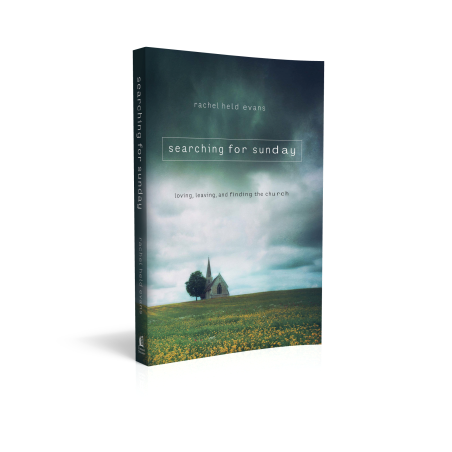
SearchingForSunday3d

In Searching for Sunday, Evans discusses, through the lens of the liturgical calendar and the seven sacraments: baptism, confession, holy orders, communion, confirmation, anointing of the sick, and marriage. Interwoven are stories of heartbreak, death, life, and the eventual conclusion of being a little bit more at home in the Episcopalian church. It’s not clear to me whether or not she ever felt like she “found” Sunday, but I think in the meantime, she’s happier there than she could be at a church that doesn’t support the ordination of women or inclusion of LGBTQA folks. In fact, at one point, she encourages those of us who attend such churches to refuse to attend, and my goodness, do I ever sometimes want to heed her cry and run off to another denomination. But: I can’t. Like so many other situations in my life, I have to make do with my current and present realities.

It’s coincidental and interesting to note that the church that she now attends is actually the first Episcopalian Church I ever attended: St. Luke’s Episcopal Church. One year my family, ever irreverent and rebellious, once protested the attendance of church services on Christmas Day in favor of spending time with family (or more realistically, sleeping in and getting to our presents first). My grandmother was so distraught at the thought of us sinners not going to a Christmas service that she wondered if we might compromise and attend church somewhere else. That’s when she came across the midnight services at St. Luke’s.

That service was transformative to me. It was beautiful, and even then as a young Republican, I found the liturgy, the spoken creeds, the simple hymns, the communal cup of wine (very scandalous for a Pentecostal teenager) for the Eucharist, and the short, sweet homily to be a religious experience unlike any I’ve ever had. Later I would come to occasionally attend Emmanuel Fellowship on Saturdays or liturgical services offered at Lee by their spirit-filled rector, Mitchell Baker, who maybe changed my theology in ways he’ll never fully understand. I attended Anglican and Catholic services during my short time in Europe, and then, of course, attended some of the most blatantly progressive Episcopal services imaginable for almost 40 days, give or take some Saturdays and sick days.

Rachel Held Evans is the storyteller that our generation needs, not just because she represents the background so many of us have, but because she’s so strong in everything that she writes, and Searching for Sunday is no exception. She is, like me, grasping at straws of Christianity in our culture and trying to see what gets rebuilt from the ashes of our broken religion, trying to show Christ to a world that only knows Christians and how different the two seem to be sometimes.

But if you think the entire book is trashing evangelicalism, you would be very wrong. She has a strong stance, yes, but she also feels genuine loss at having to make the choice to exit the movement. Losing your faith is a grief that is unimaginable, but sometimes, on the other side, it is freeing. Neither does she back away from the topic of sin, of which many liberal, progressive writers are guilty. It’s a topic that is hard to broach – but why? We are all deeply flawed and recognizing that is the first step to approaching humility, and it is in humility that Jesus Christ is found. Evans just gets it. You cannot keep insisting that Christians portray this image of capitalism and oppression and be surprised when people no longer wish to turn to Christ.

I liked Rachel Held Evans’ previous books, but I thought it would be very difficult to beat A Year of Biblical Womanhood. And boy, was I wrong. This book was a gift (a literal gift, actually!) and it just found me at the right time. I feel like Rachel Held Evans and I met at a fork in the road and ultimately took two different turns at the road. And one day, I want to find my way back to the crossroads and see what’s down her path. If evangelicalism can change into a simpler, more genuine faith, who’s to say she won’t be there to meet me?

If you’ve ever wondered why anyone would possibly still attend church even after the horrors of discrimination bills, Westboro Baptist, and slut-shaming hiding behind a misogynistic modesty/purity culture, this book is for you. If you’re cynical about faith, Christianity, and the political dome that has been built on supposedly “Christian” values, this book is for you. If you’re in a pastoral position and you are losing church members and you can’t figure out why, this book is definitely for you. I highly, highly recommend it.

And if you’re reading this blog post and you think all this progressive theology is for the birds and you want no part of it, I’m so sorry for you, and I hope you feel the love of Christ in the eyes of the broken community and reconsider your actions toward God’s people. But you, even YOU are loved by an almighty God, manifested through the figure of Christ Jesus. I leave you with a quote from the book:

“The great struggle of the Christian life is to take God’s name for us, to believe we are beloved and to believe that is enough.” – Rachel Held Evans

The Aftermath: Depression and Addiction

The Aftermath: Depression and Addiction

It’s been a little over a week since my series on Lent ended. I meant to post something on Easter, but I was not able to – the day was spent wonderfully with family and food, and I felt it was more important to live within the day instead of merely observing and write about it.

Since then, certain issues have been resolved while others linger. I applied for an Emerging Writer’s Fellowship through Buzzfeed, one that I assume (at least) five thousand other people will also apply for, but it seemed so perfect that I couldn’t resist throwing my name in the hat just in case. I have been testing chance with a touch of such meager talent, hoping for a break somewhere, and hoping one day I can really write and make money from it. Some days, that thought is the only hope I have.

In the meantime, it has been determined that my husband will have a life-changing, major surgery on June 1st. And a lesser surgery in August. It will take 6-8 weeks of recovery and I am sacrificing my pay and all my leave. I considered canceling my planned trip to Europe, but honestly, I don’t really want to. Is that selfish? It’s an-already-paid-for, once-in-a-lifetime opportunity, and I don’t think I’m obligated to deny myself that just because my husband will happen to have a surgery a few weeks later. I already sacrifice so much for the people I love and sometimes it causes me great resentment and stress. I can’t imagine how much I’d resent people were I to sacrifice this, too.

skeletorMy employment continues, thankfully, and I work harder than ever, especially now that the benefits of my position and amazing health insurance plans are so needed. I’m dutifully taking pills that aren’t making me better, so Monday I will have to try to change my prescription to force my brain to produce serotonin with its failing neurotransmitters and inability to perceive events in what the general population considers to be a thoughtful, rational way.

There’s a part of me that wants to be sad forever. As a teenager I would say that psychiatric medicine is tortuous, numbing, giving you the ability to deny your true self in favor of living a lie. If you can’t truly, deeply feel the extent of your emotions, then you’re not real. (Just exercise! Just eat chocolate! Just be yourself! Just pray and write and enjoy your life and stop worrying so much! I could do it, why can’t you?)

And as a writer, there’s a certain romantic notion attached to being hopelessly sad as it’s so poetic. Our patron saint of depression and fellow Richmond transplant and admirer, Edgar Allan Poe, stated thus: “Men have called me mad; but the question is not yet settled, whether madness is or is not the loftiest intelligence – whether much that is glorious – whether all that is profound – does not spring from disease of thought – from moods of mind exalted at the expense of the general intellect.” So, there’s that part of me that wonders if the disease of depression is not a blessing, giving me power to find melancholy and beautiful, strange, awful moods and thoughts wherever I go.

But there’s the other part of me that just wants to be able to get through a day without being crushed by hopelessness. There’s another part of me that just wants to look forward to something and actually enjoy my life and surroundings.

I work vaguely in the field of addiction. It’s a minor role and I didn’t think I would learn so much that was irrelevant to clerical duties, but I have, and I find myself with great knowledge about the subject now. In my personal life, I don’t know if I’ve directly dealt with traditional forms of addiction. Maybe caffeine, or food, or sugar, or something more abstract (such as an addiction to vanity and disordered eating, which I see run rampant now that I am aware of its existence.) A few relatives are addicted to tobacco, the villain of the marketing world. But I don’t think that anyone in my immediate familial or close friend circle has been addicted to illegal drugs, opiate/pain-reducing prescription drugs, or alcohol to my knowledge. Which makes me extremely privileged.

One of the reasons that criminal sanctions do not work on addicts who are caught with drugs, or doing something stupid under the influence of drugs, is because they can’t stop. Because if that sort of punishment was effective on addicts, they would have stopped already. They self-punish enough already, and the additional societal punishment and isolation and rejection of their friends and families and often the removal of hopes and dreams for the future (such as a steady job or education) have already not worked to get them to stop their drug of choice. Some people think if only they would stop for a certain amount of time they would be able to break a physical dependency, but of course, it’s never that simple. It’s dramatized that way on TV. Lots of people get criminal sentences for months or years where they have no or limited access to drugs, only to pick the habit right back up again once they get out. Cravings never go away. Never. And if you look at MRI scans, it’s truly a disease of the brain: the way a cocaine addict’s brain lights up with so many receptors under the influence of the drug, permanently damaging those receptors after a period of time with increased dosage so that they will never feel that way without that drug again.

Do you get it? It’s almost impossible to stop on your own. But no, no one feels sorry for addicts, they say it’s a choice and that they’re dirty and if only they’d get their lives together and stop doing stupid things, right? If only they’d just change.

The more I research addiction, the more I feel kinship with those who suffer from it. And nothing needs to be said of the link between mental illness and addiction. Addicts usually begin taking drugs to self-medicate from a mental illness, and due to the damage to the brain in long-term addiction, afterward, even if they remain completely sober, they are FOREVER far more likely to struggle with mental illness. All of us with impaired neurotransmitters and damage to the central nervous system, trying to find happiness and comfort and escape. Just to feel anything, ANYTHING differently from what it is we feel right now.

We don’t celebrate addicts or mental illness sufferers. We don’t have a month, or if we do, no one cares. I don’t know what color the ribbons are because no one wears them. Legislators actively fight to punish, not help, people with addiction and mental illness, because they don’t want to spend a dime on helping people who should be helping themselves. It’s the great lie of objectivism that people can help themselves in their own circumstances and if only we abandon them to their own devices they will either die or get better, either way, not to be a burden on a society – which is the most important thing, of course.

As Christians, I am often shocked by how many people seem to think this way because it’s so contrary to what Jesus told us to do. We regularly shame those living in poverty as creating their own circumstances, not looking to the sources of their poverty (lack of education, lack of opportunity, lack of assistance) as the reason behind it. We cheer on the successful and give them the glory, not looking at the ample privilege and support they have often been blessed with and then expecting others to gain the same success without the same initial support. We believe that a wealthy man or a famous celebrity is an image of strength and pride, while an addict living in poverty is a shame and a nuisance, despite Jesus telling us to think exactly the opposite of those people.

There is help for addicts in Jesus, but there is help for them in treatment and funding, too.

Day Forty: Holy Saturday

Day Forty: Holy Saturday

It’s the last day of Lent. Tomorrow I will drink wine and be merry, for the first time in forty days, and come Monday I may be in a dire situation with my employment and no way of securing surgery for my husband (not to mention a distinct lack of income) and who knows what I will do then. Everything can change so quickly, you know?

crossnecklace

I’ve been wearing this necklace all week for Holy Week. I have no idea how long I’ve had it or where I got it or what it means, but I love it. I was wearing it with the ichthys and gospel names out wrongly before I realized the designs, which seem Celtic at first but are actually elaborate graven images on each side, should be worn in front.

I have three tattoos on my body. One, on my right shoulder, is a caricature of Nagini the snake beheaded and pierced by the sword of Gryffindor – this was designed by a friend and then colored by JD, an amazing tattoo artist at East End Dermagraphics here in Richmond. A reminder that bravery can defeat all evils, even depression. I got this one just a few months ago. I’ve also got the words “So it goes” written underneath the nape of my neck in solid typewriter text, my ode to Kurt Vonnegut, a writer who changed my life. I got that tattoo in the summer of 2014 at Skin Graphix in Cleveland, just before I moved to Richmond. It was straight from Pinterest and onto my body via Aaron Ysidro.

On the center of back, I have a green, Celtic cross tattoo. I actually got this tattoo when I was seventeen in Tallahassee, Florida. (Now if I get a tattoo in Smyrna/Nashville area and a tattoo from San Antonio, I will have a tattoo from every place I’ve ever lived) Until last year, I intended it to be the only tattoo I ever got. I was able to convince my dad, a man who told me it didn’t “look professional” when I came home with gel pen drawings on my arms in middle school, to sign off a consent form to get my tattoo. It was from a place called No Regrets Tattoo Parlor, and true to the name – I never have.

It’s interesting, however, that the cross is a symbol of our faith. I once heard the president of “Jews for Jesus” speak at a friend’s church, and he told the scandalized audience that he found the symbol of the cross to be morbid and atrocious. Scholars say it wasn’t a symbol of Christianity until 100-300 years after the death of Christ (depending on who you ask) and several progressive Christian or anti-Christian sites like to quip that wearing the cross as a symbol is no different than wearing a gun or a hangman’s noose or an electric chair as a symbol: all represent execution.

It is quite morbid, if you think about it. Some churches, such as the Catholic church, take it a step further and leave a Jesus, nails, crown of thorns, bleeding from hands, feet, and side, on their iconography and crucifix necklaces. It’s just a bit morbid.

This is the first year that I have actively tried to describe the purpose and reason for Easter to my four year-old, who is wide-eyed and perceptive, inhaling everything I say. His curious nature is a wonder to behold and I feel completely responsible for how the sacrifice is perceived to him. We have managed to understand that Jesus is God’s son, who came to Earth, and did good stuff, and died, and resurrected. But today, while making resurrection cookies, I tried to both describe the great sacrifice Jesus made on the cross while using gentle language. I am a non-violent, semi-pacifist sort of parent, but that doesn’t mean I want my children to be ignorant of the violence in this world as it occurs. I just don’t want them to be consumed with anxiety or morbid thoughts. And as a progressive person of faith, I don’t want to shame my children into becoming preoccupied with the sin part of this instead of love. And with Rev. Jack Spong fresh on my mind, I am more cognizant of how Judaism plays into it – Passover and Easter align perfectly again this year. We watched Prince of Egypt, and I tried to explain how people used to sacrifice animals to God when they sinned (which could be a pretty disturbing thought to a four year-old by itself) but then Jesus became human and he knew how much we hurt with our separation from God’s love so he took that hurt away from us and made it where we can now connect to God, with Jesus the ultimate sacrifice to bridge us forever to God.

If I seem well-thought in my writing, I assure you I am not in person, with a preschooler, carefully trying to balance a captivating story while pressing the impact of the death and resurrection and working through what I believe to be literal and what the intention of the resurrection story is and what I think it will mean to someone who still has the blessing to view God with the pure heart of a child, untarnished by the pain of the world.

It’s not news to anyone that the cross is a rather macabre symbol of our religion. Christians have felt that way since it started being used and they were reluctant to use it, but somehow it became our identifying token anyway.

When I had this discussion with Daniel, he said, “Jesus did say to take up your cross and follow him,” and I liked that. It’s funny, because I literally wear a cross on my back, though its placement was simply because it was an easy place to cover up, and I did not think of that connection until just today. Now that I have it, I will never be able to let go of it in my mind.

Throughout the centuries, the cross has become a symbol of defiance, hatred (think of the Ku Klux Klan) and of gentle peace. The style of cross that I have permanently on my body, the Celtic cross, is the result of the attempts of early Christians who looked to convert the Anglo-Saxons by making their faith more palatable: combining the Celtic knot symbolism with the cross. People often discuss — rightfully — the horrors that some Christian missionaries have put their subjects through, sneaking pork into Jews’ food or stealing the money of the Aztecs or raping and taking their women captive or forcing converts through torture. But I would say (especially as I currently read through Silence by Shūsaku Endō!) that some missionaries of past were so kind, so thoughtful to spread their message while still maintaining the traditions of the various cultures, trying desperately to bring Christ to them at any cost, not caring about the minor details, and celebrating and incorporating their holidays into our own. I mean, we all know the pagan history of Easter, of course.

And I can wistfully say, that’s exactly the sort of missionary I wanted to be.

It’s the last day of Lent. There is no grand conclusion; I am more lost than ever when it comes to my future and my life has seemingly fallen into more disarray than when it began. Things are slipping out of my control.

But for the first time ever, I feel like I am madly in love with Jesus Christ, and I’m ready to take up ANY cross he throws at me.

Day Thirty-Nine: Good Friday

Day Thirty-Nine: Good Friday

It was a Good Friday of epic proportions. My day began with the baking and assembling of hot tea and hot cross buns, a tradition I’ve tried to keep up and incorporate. I remember attending a few Good Friday church sessions at Westmore, stations of the cross, not like the liturgical kind: a walk-through to taste sour vinegar, feel nails, and look at thorned crowns – just as a touch and see for some of the things Jesus went through. I can’t attribute this to any specific denominational practice; it just seems like an interesting thing they did for a few years, and I don’t even know if they do it any more. It was beneficial, inclusive, interesting, educational, and left a big impact on a young Jennifer.

At the end of the stations, after you sat in silence and stared at a wooden cross, they had teas, coffee, and pastries available. I always chose the Constant Comment tea, and now the two are inextricably linked in my brain. Constant Comment always reminds me of Good Friday and Good Friday makes me want to drink Constant Comment tea.

My parents arrived to play babysitter, and I was off with my husband. We drove a backward route avoiding tolls to a surgery center and I sat nervously in the waiting room with two other wives and one other husband as four people were brought back into the waiting room for the same simple procedure: a colonoscopy. I am usually vague about these things, because my husband is quite private, but Daniel has Hirschsprung’s Disease. Usually this is just a genetic thing that leads to a simple surgery and a lifetime of complications are avoided,  but this has not been the case for my husband. After many many medical issues in his childhood, he now has a colostomy bag (and yes, I double checked to make sure I could share all this information so publicly!) and now he is in a position where he needs to have a major surgery – either a reversal, or a better-placed bag. He is dealing with pain, bleeding, and tissue growth and the colo-rectal specialists are taking a great interest in him as his solution is not typical or cut-and-dry. In fact, after he woke up, the surgeon called me back to let me know he was okay. I was the last spouse to be called back and I nervously sat, wondering if something was going wrong.

“We had several surgeons and specialists in there, and we’re still not sure what we’re looking at,” they told me. “We don’t know the solution. Dr. So-and-So has published several studies though, and this is his specialty, so we’ll look at the information and you need to make a follow-up appointment for the next week.”

Just another meeting waiting in our near-future, the results of which will be life-changing for our family. Can we handle so much drastic change in one week?

I made his appointment and walked outside the building so I could drive around and pick him up in the waiting circle. Seeing him after two hours was like a burst of joy to my heart that I could not explain. In the midst of my depression and extremely uncertain financial and future circumstances, Daniel is my rock in ways I find unimaginable. A true gift from God, given to me (and often taken for granted, just as all the other gifts God gave me) at a young age. I can’t explain what Daniel means to me.

After a few hours of food, last-minute Easter errands, Daniel decided he was up to attend Lenten services with me today. As I have been going to every single service alone, I was delighted to share this experience with him – though somewhat nervous, as Daniel’s theological views are just a bit more conservative than mine, and afraid he would find offense with Rev. Jack Spong’s words. I wanted him to draw the same wonder and curiosity and appreciation I had, without becoming offended when he said things with which we likely both disagreed.

This was no ordinary Good Friday service, though. This was a three hour service, from 12-3. Six meditations, all very liturgical with a guide book for us helpless evangelicals. It was repetition: First someone prayed a traditional prayer, then a contemporary one, then we sang a hymn, then the singers (not sure if that’s what they call themselves, but a handful of robed choir members seated next to the organist!) sang a chorus, usually in Latin or German, and then someone – all seemed to be wealthy, important members of the community or family members of the rectors or both –  would come read a Bible verse that was about to be the subject of Rev. Spong’s meditation, all of which were on Matthew’s Passions, leading up to Jesus’ death on the cross. We sat, kneeled, and stood.

For three hours, Daniel would sleep intermittently on my shoulder, make grievous eye contact with me when Rev. Spong said the phrase “not meant to be literal” and try to stand and sing as best he could under the effects of lingering narcotics. We enjoyed the liturgy of it, regardless. At some point we nearly left because the exhaustion of the day got to us both, but I told Daniel I felt like I had to stay through to the end. I faced the black veiled golden cross at the center of the room and determined to stay.

As I suspected, the days of pointing out supposed Biblical flaws and pointing out the dreadful misinterpretations by us terrible Gentiles led to a glorious conclusion and I was so glad to hear it, and glad I sat through homilies that made me somewhat uncomfortable in order to get to Rev. Jack Spong’s ultimate conclusion which, as it turns outs, is the same as my own: Jesus is the ultimate manifestation of God’s love. Jesus’ last commission was not to go out and find brown-skinned heathens and torture them until they turned to the religion we wanted from them. It was to go out and treat people as he had treated us. The tale of Jewish allegory was for Jews: love the gentiles, the samaritans, the people of every race and sexual orientation and gender and walk of life, because that is what it means to worship God as fully as you can. God is the source of life and it was honored through the life of Jesus Christ, a humble figure who was so unimportant in the political spectrum that Greeks and Romans did not mention him for over a century, until the efforts of Paul brought it to their attention.

I nodded my head and said Amen, despite the fact that the entire church was silent. You can take the Pentecostal out of the Church of God, but…

I felt confused and unsettled after the three hour service, and I panicked on the way home. I messaged a good friend for philosophical insight and he was able to talk me off the ledge. I spent time with my family, tried not to think about the chance that I may be an unemployed and broke failure soon, and did a difficult yoga practice. I thought about the future which sometimes feels like it’s all I ever do.

My husband, he loves these card tricks. He watches videos of them online. Then he tries to show them to

image

me, and while his hands are deft and his manner is quick, he doesn’t always get the right card. Sometimes even if you read the directions and try to learn all you can, you’re still going to fail. I think about my career in writing and I feel like I’m fumbling, trying to find the right card, and I keep pulling up the wrong one, over and over again. Is this my card? Is this my card? Am I ever going to find the right one?

The more evangelical friends of mine have posted little things talking about how much change can happen in three days. Good Friday was not a good Friday. It was three days later than God showed up and everything was changed. I really hope that’s the case.

Day Thirty-Eight: Maundy Thursday

Day Thirty-Eight: Maundy Thursday

Maundy Thursday is a day that celebrates the Last Supper and feet washing of Jesus Christ.

image

This was supposed to be my first year celebrating it, but instead I was crying on the couch. Another day of bad circumstances, a murky future, and deep depression.

Lenten services are over and there is no service today. There is a service tomorrow, which I may or may not be attending – hopefully so. Reverend Jack Spong will be offering six meditations on the Passions in the book of Matthew, which he hopes will cause us to “never view Good Friday and Easter the same way again.”

My husband will be in the midst of a medical procedure, so I have the day off of work. I may have many more days “off work” soon if things go the way they have been going.

It’s Maundy Thursday. Jesus gathered his disciples and told them to eat the bread, which is his body, and drink the wine, which is his blood.

I’ve not yet taken Communion – Eucharist – at the Episcopalian Church. The Eucharist is not offered at the Lenten services, only at a chapel at 12:05 off the side of the main building. I’m more than happy to take the styrofoam wafer and red grape juice at my own church.  It’s like the last little act of fidelity to my evangelicalism.

I was supposed to attend an Agape Supper with my whole family tonight. They were giving away a free supper, and afterward there would be foot washing stations, and a message, and the Eucharist. I made reservations. There was a list with my name on it, and specified for children’s plates and everything. But I didn’t go. I didn’t go because I was crushed, worried even more than ever about the future.

So my Maundy Thursday went by unobserved with no bread or wine or styrofoam crackers or grape juice or foot washing. It swallowed me up and dissolved me. And I need prayer. So much prayer. For certainty and answers and assurance. For my future, and more importantly my family’s future. Because I don’t know where I’m going to go from here.

I was feeling heartbroken when I was walking around with my phone in my pocket. Suddenly, I heard some muffled music coming from it. I was frustrated, and pulled out my phone to instinctively stop the app, trying to close it, but for some reason, the song wouldn’t go away. I glanced to see what the source was: Spotify! I rarely use this app on my phone any more, and it only serves to irritate me with its inability to remove the seven notifications glaring at me in red no matter what I do, including uninstalling and reinstalling it.

The song? It was Overcome by Jeremy Camp.

Now, I don’t listen to Christian music. I listen to alt. rock and pop and literally anything else. I will spare you the cliche argument on the suckiness of modern Christian music and most other forms of Christian entertainment. You’ve heard it. You might agree. The closest I get to Christian music is like, U2 or mewithoutYou. Especially the latter. But stuff like that: not overtly Christian, certainly not fundamentalist and white-washing and blatantly worship-y in nature.

Now, that’s not to say I don’t know the song Overcome. I don’t loathe Christian music so much that I can’t get into praise and worship music at church on Sunday morning. At that point it is refreshing, and as stated before elsewhere in this blog, I usually prefer it to hymnal music – at times, anyway. This song was often played with much heart at my former childhood church.

But I can assure you I’ve never listened to that particular song on Spotify, and I have no idea why the song popped up in my pocket at random. A quick jostle of the hips shifting against the fabric of my pants and all of a sudden God is speaking to me.

Also – and this is a story I’ve never shared before – I’ve actually met Jeremy Camp. It’s true. In 2005 I attended a church that I hated, First Baptist of Tallahassee. I didn’t get along with the kids of the youth group and instead ran around with an eclectic group of agnostics, Jews, and Wiccans with whom I had much more in common. But my mom pushed me into attending this Disciple Now or Discipleship Now weekend or whatever it was. A weekend spent at some rich person’s house with a group of youth students who rarely talked to me, pastoral figures, and a special leader/worship singer who was there to help lift and invigorate the mood: a young, almost famous Jeremy Camp.

He was four years removed from the death of his first wife from ovarian cancer, a disease which also took a childhood friend of mine recently. His wife was just 21. By then he was already remarried with a baby. He talked about silly subjects with high school girls and plucked on his guitar and shared the story of how he fell back into God after his wife died.

I, of course, shared my reluctant attitude and general mopey demeanor throughout the entire weekend, though during the “personal sharing” time where an adult figure came and talked to me one on one, I told her sometimes it was so hard to have faith and I didn’t know why. I don’t remember her response, but then she french braided my hair, and it was the only nice thing anyone did for me that I actually appreciated all weekend. I have never been able to french braid. Maybe french braiding a weird girl’s hair is as close to a maundy ceremony as that girl ever got.

Memories of that weekend are so vague that I wasn’t even sure if it really was Jeremy Camp, playing his guitar at what was essentially a slumber party. If it wasn’t for the guitar playing and the distinct memory of the storytelling of his struggle with grief, I probably wouldn’t have remembered his name later when I heard his music being played at Lee University and Westmore.

And here he was again, singing into my thighs, a promise to me that I will overcome by the Blood of the Lamb and the words of our testimony. Everyone overcome. 

I want to overcome too. I want to overcome my fears and weaknesses and doubts. I want to overcome the next few weeks when I no longer have my lunchtime escape into the blood red pews and gold and white marble wonder. I want to overcome my failure and depression. And on the otherwise, I want a life that is devoted to Christ in an unbelievable way. I want every aspect of my life and my writing and my career to be for the benefit of the Kingdom and all its glorious creation here on earth.

If I could wash the feet of every prisoner, beggar, or Wall Street executive, I would. God, I would. I will overcome this nightmare and I will find pure, unadulterated love on the other side.

“You’re always a work in progress,” said my dad. “You will be until you take your very last breath.” You always keep going.

Day Thirty-Seven: Pain in the Jaw

Day Thirty-Seven: Pain in the Jaw

Every now and then, my body likes to remind me that I’m getting older and one day it will wear out and I will die. Right now, I have a dull, throbbing ache on the left side of my jaw. I only notice it when I open my mouth widely or rest my chin on my palm or think about it, such as when I’m writing about it, for instance.

Who knows why? I grind my teeth terribly at night. I have bitten through two expensive mouth guards (I’m on my third) and several more of the cheap ones. This is a mixture of genetics (both my parents do it) and anxiety (for which there is seemingly no cure) and though I try desperately to maintain control over my life, I can’t help what I do in my sleep.

Maybe it’s the tooth implant I had put in the left side of my mouth when I was told one of my teeth didn’t have a root and I should go ahead and have an implant placed. Maybe I’m about to have a heart attack. Maybe I have a TMJ disorder. Maybe it’s early-onset arthritis. Maybe my night grinding has managed to stop ruining my teeth and move onto ruining my jaw. Maybe it’s psychosomatic.

But either way, I’m not wont to do anything about it. I have a check-up appointment in a few weeks with a general doctor, I’m sure I can just mention it then if it’s still there. It’s just a nuisance really. One of those nuisances that can really creep up on you if you don’t watch it.

My grandmother, with a delightful plethora of painful medical conditions, took medication that kept her alive and also destroyed the collagen in her joints, part of which was the jaw. The bones of her mandible ground against her skull, but it never changed her behavior: she continued to chew ice (a bad habit of hers I picked up but have now greatly reduced, though not quit completely) and do whatever she wanted, as she always did.

Many people are irritated and fascinated with our society’s chronic complaining in our first world, privileged society; a criticism which has its merits, but personally, I find it more amazing how people go through life accepting these little nuisances and pains, and not only ignore them, but aggravate them and make them worse!

We all become comfortable in our bad habits (a subject I dare not touch, lest I be the ultimate hypocrite) and worse, become comfortable with the pain that attacks us. And before you know it, you’re just like the subject of the oft-posted cartoon below!

KC Green

It’s incredible the amount of pain we allow ourselves to live in for various reasons ranging from complacency to sacrifice, without doing anything about it. As for me, I’ll take the pain in the jaw, but I’d rather figure out a way to stop the internal pain: the one where I fret about my complete lack of future happiness and long for some untold dream of writing and preaching that may never come true.

Read more ›

Day Thirty-Six: The Midrash

Day Thirty-Six: The Midrash

It was amazing. Everything from my last post seemed to fall into place. I was okay; no, I was more than okay. I had some kind of unexplainable inner peace and joy. Did my circumstances change? Nope. Did my attitude? Not by some outwardly attempt on my part. Having had clinical depression for my whole life, I know you can’t just decide to be positive at the drop of a hat, no matter what any kitten poster tells you.

I took the whole day in stride so God sent me some interesting curveballs to keep me on my toes: the building I work in was evacuated because of a gas leak, and I spent an hour basking in a perfect spring day because of it.

Before our building was cleared, it was time for Lenten services. This week the old rector of St. Paul’s is speaking, Reverend Jack Spong. An established author, he is easily the most progressive speaker who has come so far. I don’t think anyone I know personally in my life who calls themselves an evangelical Christian could sit through one of his sermons. If you look through his biography, you’ll see what I mean. Many people think he’s the embodiment of liberal theology but I don’t know if that’s true for all of us. I think I come from pretty post-modern thinking in my theology and I felt pretty uncomfortable at times, but it was a good uncomfortable. I didn’t always agree, but I liked hearing what he thought and how it changes his worldview.

Midrash

He told us he was raised into anti-semitism from his childhood as an Episcopalian. It’s interesting to note that the more fundamentalist church of my youth was and is extremely pro-Israel and I was raised with respect for their religion for as long as I can remember. Other people and groups and religions might be wrong and harmful, but not Jews. They are still God’s chosen people. Maybe our support was more political in nature, but in a way, I have to credit this behavior to my (Christian) humanist ideologies now. Liturgical denominations, especially decades ago, had a tinge of anti-Semitic thinking (expressed by such people as Mel Gibson, for example)

He said he was shocked upon learning that Jesus was a Jew. And his disciples were Jews. And the writers of the Gospels were Jews, writing their story in a context for Jews. It was Paul who reached the Gentiles for Jesus, and as much as post-modernists grumble about Paul, they have him to thank for their faith and the incredible impact he made.

He described how the gospels were written in the spirit of midrash.

Now I consider myself an educated person in matters of theology, and self-taught of basic Jewish principles. But that word, that entire concept was foreign to me.

In essence, Jews, mostly through oral tradition which was (and is) heavily important, made concepts more understandable by filling in the holes of a story with something from the past.

Now, he argued (and warned us that we did not have to agree!) that Joseph could have been a fictional character created to show the legitimacy of Jesus. Matthew gave him the name and similarities of Joseph from the Old Testament to instill the sense of unity and compassion among any Jewish readers who would be taking the story in. It’s a story weaving in unity with the choice of words, and each word is so deliberate and breathed by God to bring about understanding of his nature through this Jesus Christ.

Now, don’t panic. I know Rev. Jack Spong’s 12 points of reforming Christianity. And I gotta say, I don’t buy half of them. Here is a theologian who has preached everywhere, mentored under the greats, published life-changing, top-selling literature for Christian research. And he said Joseph wasn’t mentioned anywhere else but Matthew 1 and 2. And I, a mere regular joe Christian, immediately thought of Luke’s narrative of the 12 year-old Jesus where his mother worried and said “Your father and I were worried about you.”

True, that doesn’t give Joseph by name. But Luke is my favorite gospel. Because Luke was like a journalist: he had a mission to find out the most accurate facts as possible, and report back to Theophilus. I LOVE that. I also find it to be the most legitimate.

So I sat there enjoying his perspective, learning important ways to challenge my thinking (I will wonder how else I can read the Bible through Jewish eyes!) and comfortably disagreeing with some of his viewpoints.

And then I wondered, why do I find that so hard to do when a pastor preaches about homosexuality as sin (like they don’t know what you think) or submissiveness of women? (Like we don’t feel the harmful effects of this thinking on a daily basis as we deal with basic injustices) Why does that make me squirm and feel uncomfortable, but someone who preaches from the perspective of really rejecting any Biblical literalism whatsoever makes me shrug and ponder and disagree while still finding the meaning of his message (Jesus represents unity of the broken Jewish community and selfless love of God) even through this disagreement?

But if a pastor even hints at some common fundamentalist thought about hellfire and sin and Muslims and gays, I completely shut down and become hostile to the rest of the message?

Because God can speak through even the most deist-thinking liberal Christian and through the most fundamentalist, conservative Bible thumper. He sends different people with different opinions to touch as many of us with his love as possible. Well, gee.

I’ve been reading through the Bible with increasing regularity and I am going to do more research to find instances of midrash in the Scripture. I want to know the language God spoke to His people with. And maybe then I can speak that language to other people. I want to be “multi-lingual” when it comes to my interpretation of Christianity. No, not heretical. It’s why I find expression of God in many church settings, and also why each churchis never a “perfect” fit for my particular opinions or feelings.

I just want to know how I can make Jesus Christ seem like home. I think Jesus has a particular talent to make each person he met want to find out more and follow him, and we’ve all been failing and succeeding at that simultaneously ever since. Paul did a pretty good job; writing different letters to different churches. No church has a one-size-fits-all theology and neither does each person. For me sometimes I have different theological approaches just based on my mood or day! And somehow, Jesus still centers at all of them.

Day Thirty-Five: Just Until

Day Thirty-Five: Just Until

Yesterday was Palm Sunday and I spent the morning waving palm leaves high in the air and singing “Hosanna, hosanna, hosanna in the highest!” the old Church-y hymn that reminded me of parading through purple seas in the old Westmore Sanctuary toward Pastor David Bishop, a true Christian and someone who understood the importance of kindness and art in every word he spoke and every movement of his fingertips. And now he’s celebrating eternally, but I’ve only got about 70 years left, and I’m overweight, so statistically, it could be a lot lower than that.

When Jesus arrived in Jerusalem it was to a happy chorus of grateful people, welcome to receive Him into their city. My, how quickly things changed and how quickly hearts were turned and how quickly they encouraged his execution upon the cross after he got too bold and too radical. How quickly we crucified the same Savior who we were only just praising.

And now, we have the tendency to do the same thing.

I had a terrible, horrible, no good, very bad day.

alexander

I had to travel for work and spend all day in a training session. I got to see a friend, which was nice. But I also had to hear sad stories, get a crick in my neck, sit in a room full of people where not a single soul spoke to me for eight hours, brave metro traffic, miss out on time with my family, and feel unappreciated and worthless at my job. And of course, I had to miss Lenten services for today, which is Holy Week. I may have to miss them on Wednesday too, because then I have to CONDUCT a training session.

I ended up crying all the way home.

Even though yesterday I had been praising God, feeling good, and thanking Him for all my blessings, today I was depressed beyond all rational thought. It’s amazing how quickly all that turned.

I could let these feelings fester for the rest of the week, and easily get angry at God for my circumstances. Not enough money. Too much stress. A complete lack of fulfillment. The desires of my heart feel like they are being crushed. Are my dreams dying? Am I letting them slip away? Last year, I blamed God for every single negative circumstance that befell my family. It was a constant roller coaster: me versus God, and my emotional outpouring on Him. I could, and probably one have been, one of the people shouting “crucify him!”

And it’s not a problem for God. He can take my anger, my wrath, my blame, even my hatred. It’s a problem for me. He overcame the crucifixion His people put Him through. The person it kills is ME.

I don’t have to shout Hosanna, or pretend to be joyful when I’m not. But I have a God who says I can trade my sorrows. He doesn’t say He’ll wave a magic finger and fix it. He says I can choose to trade my sorrows. And joy comes in the morning.

I talked to a friend today and she emphasized to me: you just have to wait until. Just until. Until my circumstances change. Because they will not be forever. I have been told that my words speak life or death, and that’s part of the reason I started this blog series.

I’m choosing to speak life, even when my eyes are filled with tears and I don’t know what tomorrow will bring.